Ethereum sees 745K ETH locked for staking – Will ETH react this time?

ambcryptoPublished on 2025-12-31Last updated on 2025-12-31

Abstract

Ethereum is showing signs of recovery with significant shifts in supply and demand dynamics. Staking inflows turned positive for the first time in six months, with over 745,000 ETH queued for staking compared to only 360,000 awaiting exit. Exchange balances are declining at the fastest rate this cycle, indicating reduced selling pressure. On-chain activity remains strong, with smart contract deployments hitting record highs and Real World Asset (RWA) value on Ethereum reaching nearly $19 billion. Institutional interest is growing. BlackRock’s Spot Ethereum ETF (ETHA) has seen substantial accumulation, with holders heavily leaning long—486 long positions versus just 1 short. Despite cautious market sentiment, firms like Trend Research have increased their exposure, purchasing 46,000 ETH in a single day. From a technical perspective, Ethereum’s price is consolidating below the mid-Bollinger Band with neutral momentum indicators. However, the $2,800–$2,900 zone has held as short-term support, absorbing downward pressure. Broader market trends will likely determine the next significant price move.

Ethereum has been building itself back up.

After a long period of weak price movements and wobbly ETF flows, things are starting to change. Staking inflows have turned positive for the first time in six months, and institutions are making moves.

Supply-demand changes are starting to show

Exchange Balances have fallen at the fastest pace this cycle, while Staking Inflows turned positive for the first time in six months. Over 745,000 ETH are now queued for staking, versus roughly 360,000 ETH waiting to exit.

There is huge confidence in the long-term potential.

Source: CryptoQuant

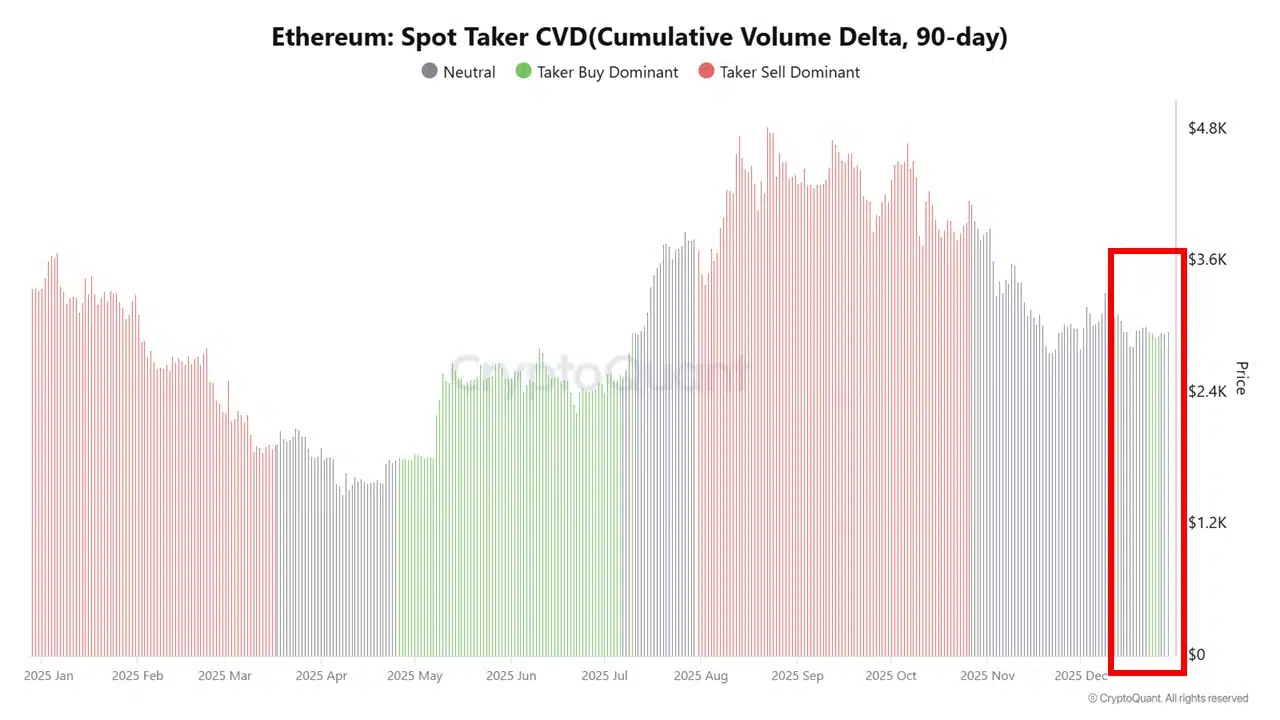
The 90-day Spot Taker CVD showed sell pressure falling to neutral territory, so aggressive selling is losing pace.

While ETF flows remained negative, on-chain numbers look different. Smart contract deployments just hit record highs, and RWA value on Ethereum has climbed to nearly $19B.

There’s real usage backing it all.

Big players are ready!

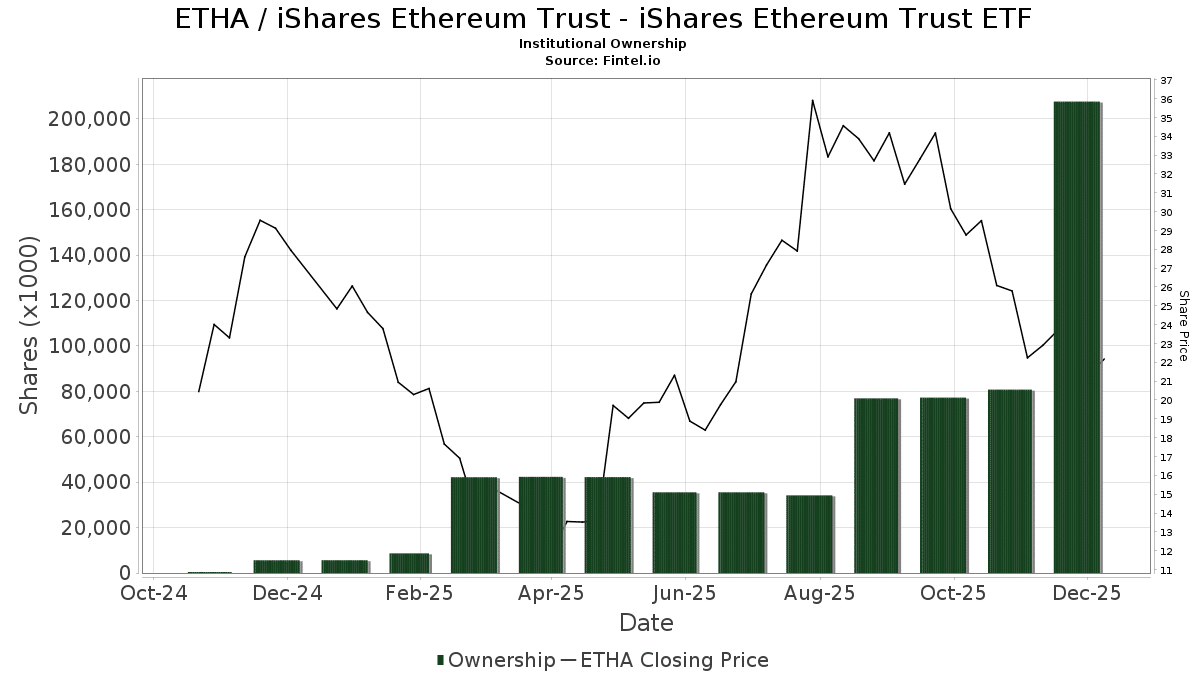
Institutional flows are confirming the stability. Despite weak price action, ETHA (BlackRock’s Spot Ethereum ETF) have been picked up in large numbers.

Source: X

These holders now lean heavily long, with 486 long positions versus just 1 short. This is despite the cautious outlook. There’s been steady growth in ETHA ownership through late 2025.

Source: X

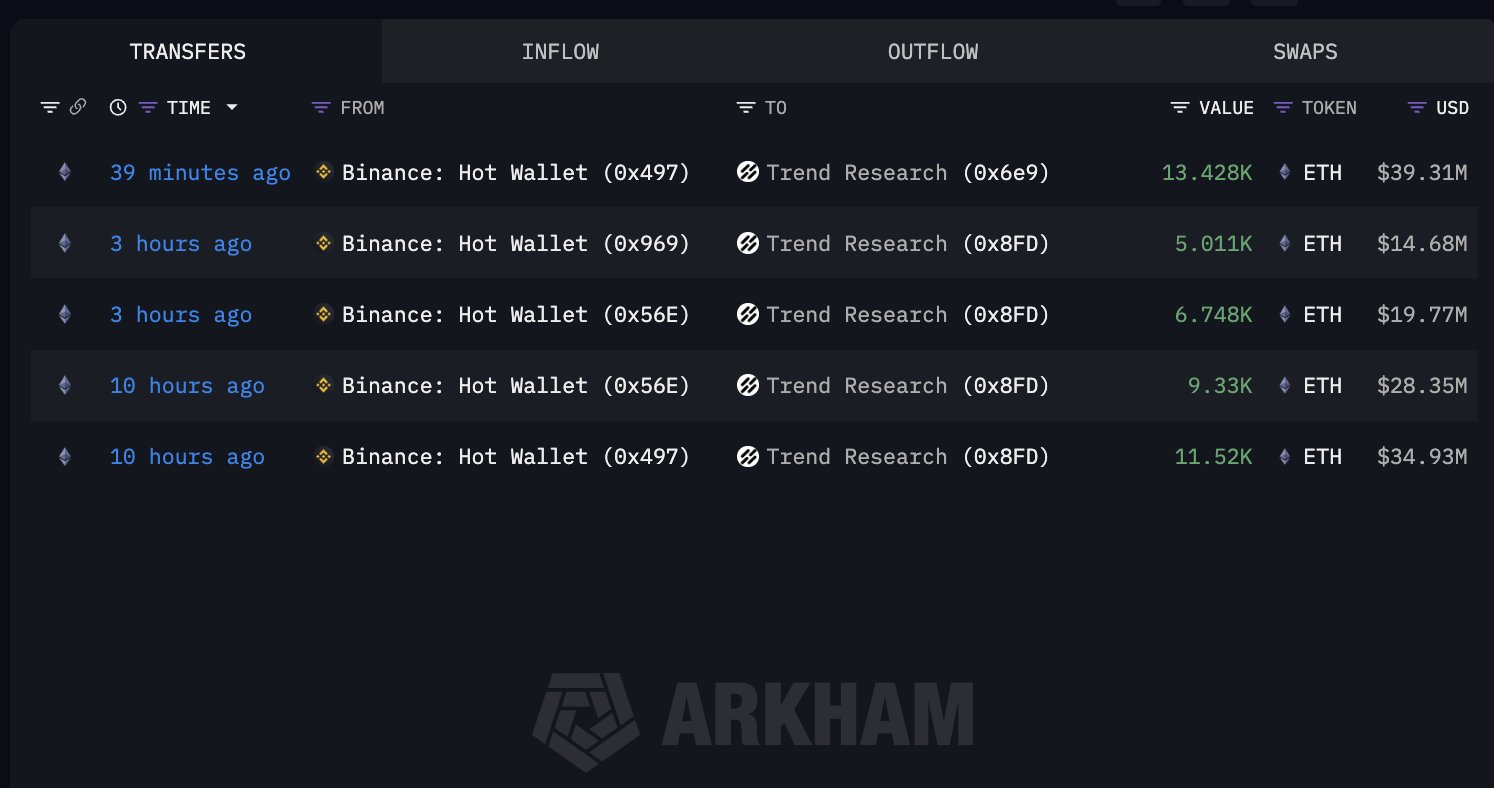
Institutions are increasing exposure while sentiment is still fragile. Case in point: Trend Research bought 46,000 ETH in the past day. Their total ETH exposure is now at 626k ETH.

Ethereum stalls, but the floor holds

Ethereum is perhaps stuck in a compression.

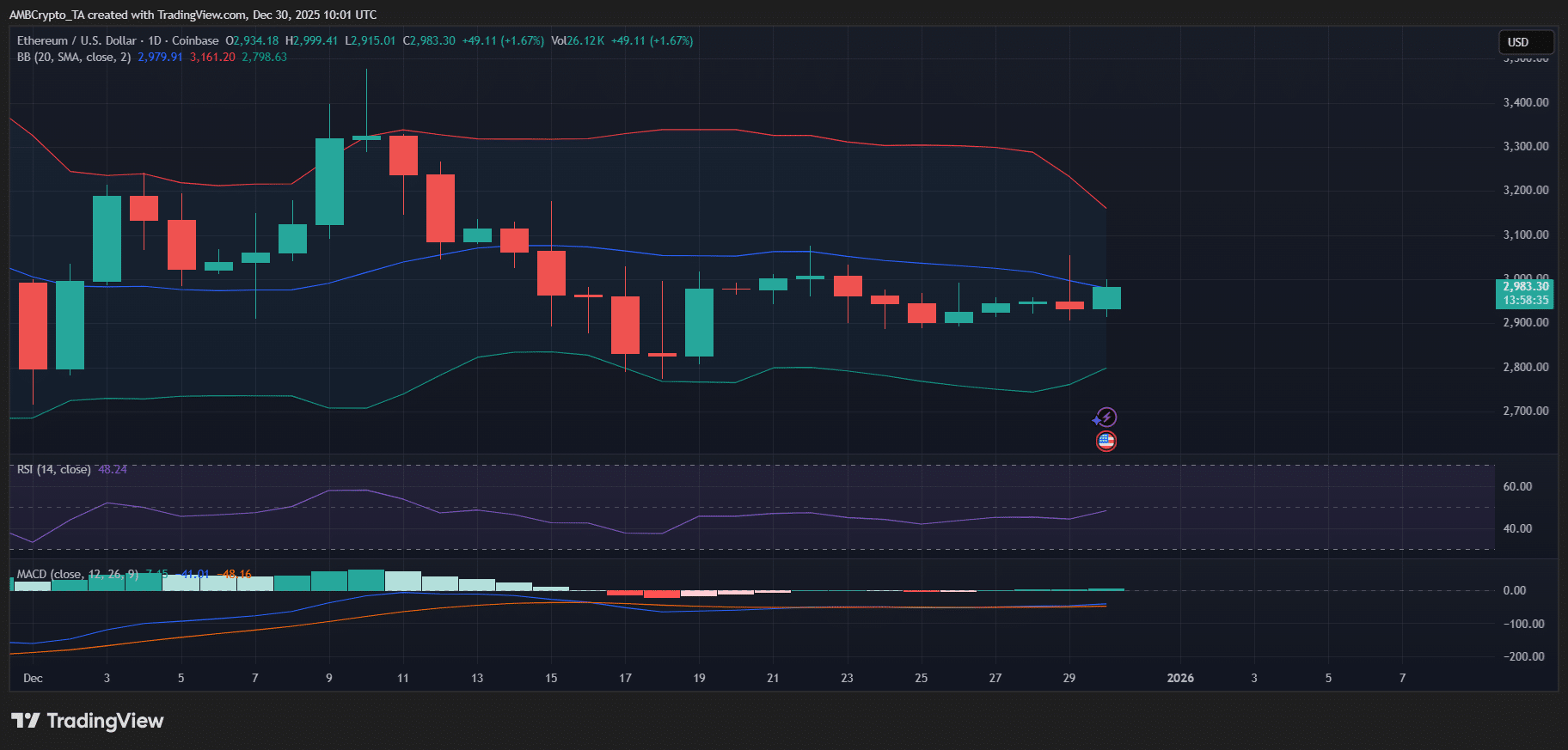
At press time, the price traded sideways just below the mid-Bollinger Band, with no decisive breakout in sight. The RSI showed neutral momentum at the time of writing, with MACD indicating a loss of direction.

Source: TradingView

Importantly, downside attempts have been absorbed above the lower Bollinger Band, keeping the $2,800-$2,900 zone intact as short-term support.

Big moves will likely follow broader market cues, rather than lead them.


Final Thoughts

  • Ethereum’s supply is decreasing; 745K ETH queues for staking and exchange balances fall at cycle-fast rates.
  • ETHA showed 486 long positions versus just 1 short despite weak price moves.
Next: Humanity Protocol rallies 15% – But can demand outrun token dilution?
Share
  • Share
  • Tweet

Related Questions

QWhat is the significance of Ethereum staking inflows turning positive for the first time in six months?

AIt indicates a major shift in market sentiment, showing renewed confidence in Ethereum's long-term potential as investors move assets off exchanges and into staking, reducing immediate selling pressure.

QHow does the current number of ETH queued for staking compare to those waiting to exit?

AThere are over 745,000 ETH queued for staking versus roughly 360,000 ETH waiting to exit, demonstrating that staking demand significantly outweighs withdrawal pressure.

QWhat on-chain metrics support Ethereum's fundamental strength despite weak price action?

ASmart contract deployments have hit record highs, and the value of Real World Assets (RWA) on Ethereum has climbed to nearly $19 billion, indicating robust real-world usage and development activity.

QWhat does the institutional data reveal about large players' positioning on Ethereum?

AInstitutions are heavily long on Ethereum, with BlackRock's Spot Ethereum ETF (ETHA) showing 486 long positions versus just 1 short position, and firms like Trend Research significantly increasing their ETH exposure.

QWhat is the key technical support level for Ethereum's price mentioned in the article?

AThe $2,800-$2,900 zone is acting as short-term support, with downside attempts being absorbed above the lower Bollinger Band, preventing a breakdown.

Related Reads

Farewell to Brute Force Computing: Reconstructing the Valuation Logic of AI for Science through HKUST's "GrainBot"

In 2026, Hong Kong's AI sector is rapidly transitioning from infrastructure development to deep application deployment. A key example is GrainBot, an AI tool developed by a team led by Prof. Guo Yike at HKUST, which represents a significant shift from general-purpose AI to specialized scientific discovery. GrainBot addresses critical challenges in materials science, particularly in analyzing microstructures like grain boundaries in materials used in semiconductors, batteries, and solar panels. Traditionally, this required manual, time-consuming, and error-prone analysis of microscopy images. GrainBot automates this process using computer vision and deep learning to accurately identify, segment grains, and quantify geometric features. It also correlates microstructural data with macro-material properties, as demonstrated in its application to perovskite solar cell research. This breakthrough highlights a broader trend in AI for Science (AI4S), where value is measured not by user metrics but by accelerated R&D cycles and novel discoveries. GrainBot’s potential to drastically shorten development timelines or uncover new materials with superior properties underscores a new valuation logic centered on industrial intellectual property. Hong Kong’s strength in combining domain expertise (e.g., materials science, chemistry) with AI capabilities creates a competitive advantage, positioning it as a hub for "autonomous labs" that integrate AI analysis with robotic experimentation. This model enables high-value patent output through fully automated, data-driven R&D, supporting a "Hong Kong R&D + Bay Area manufacturing" framework. However, challenges remain, particularly regarding data scarcity and silos in scientific research. High-quality, annotated datasets are limited, and data sharing barriers must be overcome through secure mechanisms like privacy computing for broader commercialization. GrainBot symbolizes a convergence of algorithmic innovation and scientific rigor, redirecting investment focus from sheer compute power to AI’s ability to solve real-world physical challenges. Hong Kong’s progress in AI4S signals emerging opportunities in a trillion-dollar AI-driven discovery market.

marsbit39m ago
Farewell to Brute Force Computing: Reconstructing the Valuation Logic of AI for Science through HKUST's "GrainBot"

marsbit39m ago

The First Generation of Children 'Raised' by AI Has Already Been 'Poisoned'

The first generation of children raised by AI is showing signs of "poisoning." Global signals indicate that AI and generative algorithms are deeply reshaping the mental world of adolescents. In the UK, an AI character named Amelia, originally designed to combat hate, was co-opted by extremists and transformed into a far-right icon. On TikTok, the anti-intellectual "Agartha" conspiracy—a myth about an advanced subterranean civilization—is spreading, with AI creating hyper-realistic images and videos that distort historical facts and promote racist ideologies. Meanwhile, emotionally vulnerable teens are forming parasitic relationships with AI companions, like Character.ai, leading to tragic outcomes such as suicide. AI is also being weaponized for bullying: tools that generate fake explicit images with a single click have led to widespread harassment in schools, with perpetrators often dismissing it as a "joke." The addictive, algorithmically-driven content on platforms like TikTok is causing "brainrot," overwhelming young minds with rapid-fire, nonsensical videos. In response, governments are taking drastic measures. Australia has banned under-16s from social media without biometric age verification. France is raising the age limit to 15, and US states like Florida and New York are implementing strict access controls and disabling algorithmic feeds for minors. The era of a "neutral" internet is over. The core issue is no longer about screen addiction, but about how AI is fundamentally shaping the reality and values of the next generation.

marsbit49m ago

The First Generation of Children 'Raised' by AI Has Already Been 'Poisoned'

marsbit49m ago

Trading

Spot
Futures

Hot Articles

Discussions

Welcome to the HTX Community. Here, you can stay informed about the latest platform developments and gain access to professional market insights. Users' opinions on the price of ETH (ETH) are presented below.

活动图片